CIX369 / NOOB TO PRO / FREE GUIDE
Candlesticks & Chart Patterns
Candlesticks & Chart Patterns. Your second free Noob to Pro guide, with a visual reference, the videos from the CIX archive and a practical study routine.
What does one candle tell you?
Four prices. One chosen interval. No guarantee about the next candle.
OPEN, HIGH, LOW, CLOSE
The open starts the interval; the close ends it. The high and low mark its extremes. The body spans open to close. Wicks show the distance to the high and low. In our preferred colours, green closes above the open and red closes below it.
TIMEFRAME CHANGES THE QUESTION
A five-minute candle and a daily candle describe different windows. Check the timeframe and whether the candle has closed. A shape can change while the candle is still forming.
START WITH CONTEXT
Is price trending or moving within a range? Where are prior highs, lows and areas with repeated reactions? How liquid is the market? A pattern in the middle of random noise gives you less to work with than a pattern at a meaningful level.
ONE SIMPLE EXERCISE
Choose a closed candle. Write down its open, high, low and close. Explain what buyers and sellers did during that interval without predicting the next candle.
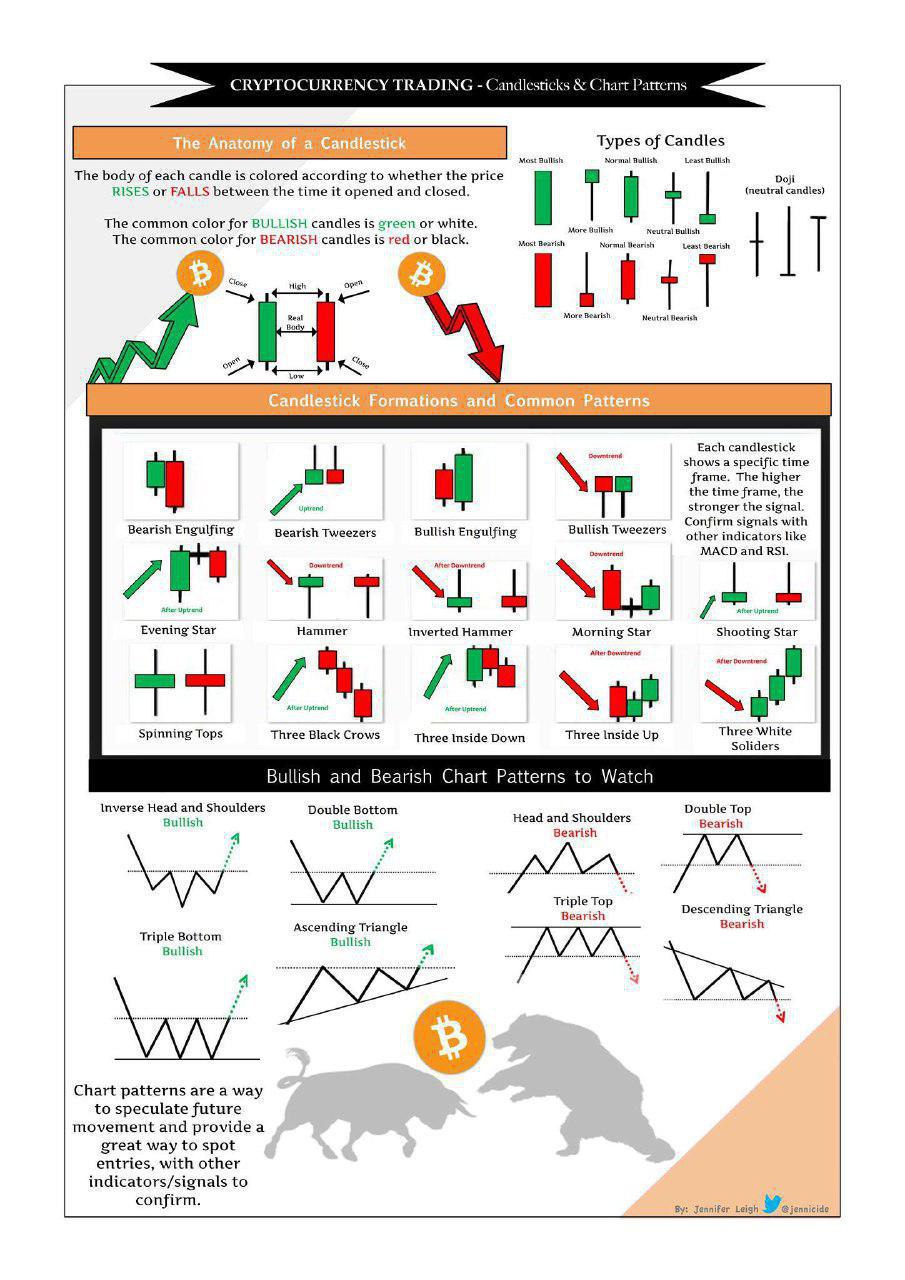
The archive reference sheet.
The visual overview shared in the early CIX guide channel.
HOW TO USE IT
Use the sheet to recognise names and shapes. Its bullish and bearish labels describe conventional interpretations, not reliable forecasts. A longer timeframe does not make a pattern automatically stronger.
Start with these candle patterns.
Learn a few well before trying to memorise everything.
ENGULFING
A bullish engulfing pattern has a green real body that covers the preceding red real body, often studied after a decline. Bearish engulfing reverses the colours and is studied after a rise. Check body definitions, the trend and the next price action.
HAMMER / SHOOTING STAR
A hammer has a small body with a long lower wick, commonly studied after a decline. A shooting star has a small body with a long upper wick after a rise. Similar shapes elsewhere can mean something different.
DOJI / SPINNING TOP
These have small bodies relative to their range. They show that the open and close were close together, not that a reversal is guaranteed. Context matters more than the label.
MORNING / EVENING STAR
Three-candle reversal structures combine a strong initial candle, a smaller middle candle and an opposing third candle. Textbook gaps are less common in continuously traded crypto markets. State the exact criteria you use.
The chart is bigger than a candle.
Structure helps you decide what would confirm or invalidate an idea.
DOUBLE TOP / DOUBLE BOTTOM
Two reactions near a similar area can form a candidate structure. A double bottom is not confirmed just because the second low looks attractive. Traders often watch the intervening high or neckline and the quality of a break.
HEAD AND SHOULDERS
Three swing highs, with the middle highest, can form a head-and-shoulders candidate. The inverse form uses lows. The neckline, trend, completion and possible failure all matter. A name alone is not an entry.
TRIANGLES
Ascending and descending triangles combine one comparatively flat boundary with a sloping boundary. Do not assume price must break in the textbook direction. Record which boundary actually breaks and whether the move holds.
A RANGE IS ALSO A STRUCTURE
For the Account Builder, repeated movement between recognisable boundaries is the starting point. It still needs liquidity, reasonable costs and a clear point at which you stop treating it as a range.
Watch the lessons. Then practise.
Two video resources from the original CIX archive. Watch critically, then check a chart yourself.
01 / CANDLESTICK COURSE
The Ultimate Candlestick Patterns Trading Course (For Beginners), by Rayner Teo. Watch the explanation of candle anatomy and the role of context. Pause before each example’s outcome and write what you can actually observe.
02 / CHART PATTERNS
The second chart-pattern resource linked in the archive starts at 18:49. The original message listed this same URL twice under different descriptions. It is one resource, not two separate lessons.
TURN WATCHING INTO LEARNING
Pick one pattern. Define it in plain language. Mark ten historical examples, including failed examples. Record the prior trend, level, confirmation rule and invalidation. Hide the future candles while making each note.
THE LINKS
Video 1: Watch the archive video ↗
Video 2: Watch the archive video ↗
Your first chart review.
You can do this without placing a trade.
OBSERVE
Asset and contract if relevant. Venue and pair. Timeframe. Trend or range. Liquidity. Whether the candle is closed.
FORM A TESTABLE IDEA
What exact event would make the setup interesting? Where would it fail? What would happen if the price breaks in the opposite direction? Do not write the answer after seeing the result.
REVIEW BOTH SIDES
Compare successful and failed examples. Include costs and realistic execution if you calculate a hypothetical return. A few attractive charts cannot establish a win rate.
NEXT IN YOUR JOURNEY
Use the free Account Builder Playbook to connect chart selection with ETH-denominated accounting, order planning and liquidity. Join the weekly Noob to Pro course for a steady sequence of lessons instead of trying to absorb everything in one night.
Sources and edition
Updated 21 September 2026 from the supplied CIX archive. Historical examples are educational.
- Original reference sheet: Jennifer Leigh / @jennicide. Supplied CIX archive image, reproduced with its visible credit.
- CIX archive video 1: Official resource
- CIX archive video 2: Official resource